

Parenting Plans vs. Parenting Orders Explained (2026)
By Gavin Lai
Updated to February 2026
When parents separate, most people are not looking for legal jargon. They are looking for a way to reduce uncertainty, protect their children, and avoid repeated conflict.
One of the most common questions we hear at Emerson Family Law is:
“Should we do a parenting plan, or do we need parenting orders?”
They can look similar on paper. The practical outcomes can be very different.
In this guide, I’ll explain what each option is, how they work in Australia, what has changed in family law since May 2024, and how to choose the approach that best supports your child’s stability.
If you want a broader overview of how parenting issues are handled after separation, start with Emerson Family Law’s guide to children’s matters.
Table of Contents
- Parenting Plans vs Parenting Orders: Key Differences and Considerations
- What is a Parenting Plan?
- The Key Limitation That Catches Parents Off Guard
- What Are Parenting Orders?
- Parenting Plans vs Parenting Orders at a Glance
- When a Parenting Plan Is Usually the Right Choice
- When Parenting Orders Are Usually the Better Option
- The Nuance Many Parents Miss: Parenting Plans Can Affect Existing Parenting Orders
- Up-to-Date Law: What Changed From 6 May 2024 and Why It Matters Here
- Decision-Making: Parental Responsibility vs Time With Children
- Practical Considerations That Make Parenting Documents Work in Real Life
- 11.1 Make the Routine Specific
- 11.2 Plan for School Holidays and Special Days
- 11.3 Include a Dispute Pathway
- 11.4 Watch Out for Relocation and “Where the Children Live” Disputes
- 11.5 If You Are Dealing With Alienation Concerns, Get Advice Early
- Parenting Plan Vs Parenting Orders: How to Choose
- Frequently Asked Questions People Search For
- 13.1 Are Parenting Plans Legally Binding in Australia?
- 13.2 Can a Parenting Plan Override Parenting Orders?
- 13.3 What Happens If Someone Breaches Parenting Orders?
- 13.4 Will the 2024 Family Law Changes Affect Existing Parenting Orders?
- A Note on Tone, Safety, and Your Child
What is a parenting plan in Australia?
A parenting plan in Australia is a written agreement between parents that records the arrangements you have agreed to for your children.
It usually covers the everyday realities such as where the children live, how time is shared, changeovers, school holidays, communication, and how decisions will be made. If you want a simple baseline definition, Emerson Family Law explains this clearly in The ABCs of Family Law under the entry for parenting plan.
A parenting plan is often a good option when:
- communication is workable
- there is genuine willingness to cooperate
- you want flexibility as routines settleù
- you are trialling arrangements before making them more formal
You will also see parenting plans discussed in practical contexts like holiday scheduling in Ask a Child Custody Lawyer: Arrangements Over the School Holidays.
The key limitation that catches parents off guard
A parenting plan is not a court order.
That matters because if a parent later stops following it, a parenting plan is not enforced in the same way as parenting orders. This is one of the reasons we often see parents move from informal arrangements to formal orders when reliability becomes an issue.
If you are already dealing with non-compliance, Emerson Family Law’s article What Are the Consequences If You Breach a Family Court Order? explains how contraventions work when orders exist.
What are parenting orders in Australia?
Parenting orders in Australia are legally binding orders made by the Federal Circuit and Family Court of Australia.
They can be made:
- by agreement through consent orders, or
- after a contested court process if agreement cannot be reached
Definition of a consent order
A consent order is an agreement between the parties that is approved by the court and then becomes a court order which is legally binding and enforceable.
When parenting orders are in place, both parents must comply. If someone does not, the Court can deal with it through compliance processes, including a contravention application. The Court’s own guidance on enforcement is set out in the Federal Circuit and Family Court fact sheet on compliance with parenting orders.
Parenting plans vs parenting orders at a glance
Here is the difference that matters most:
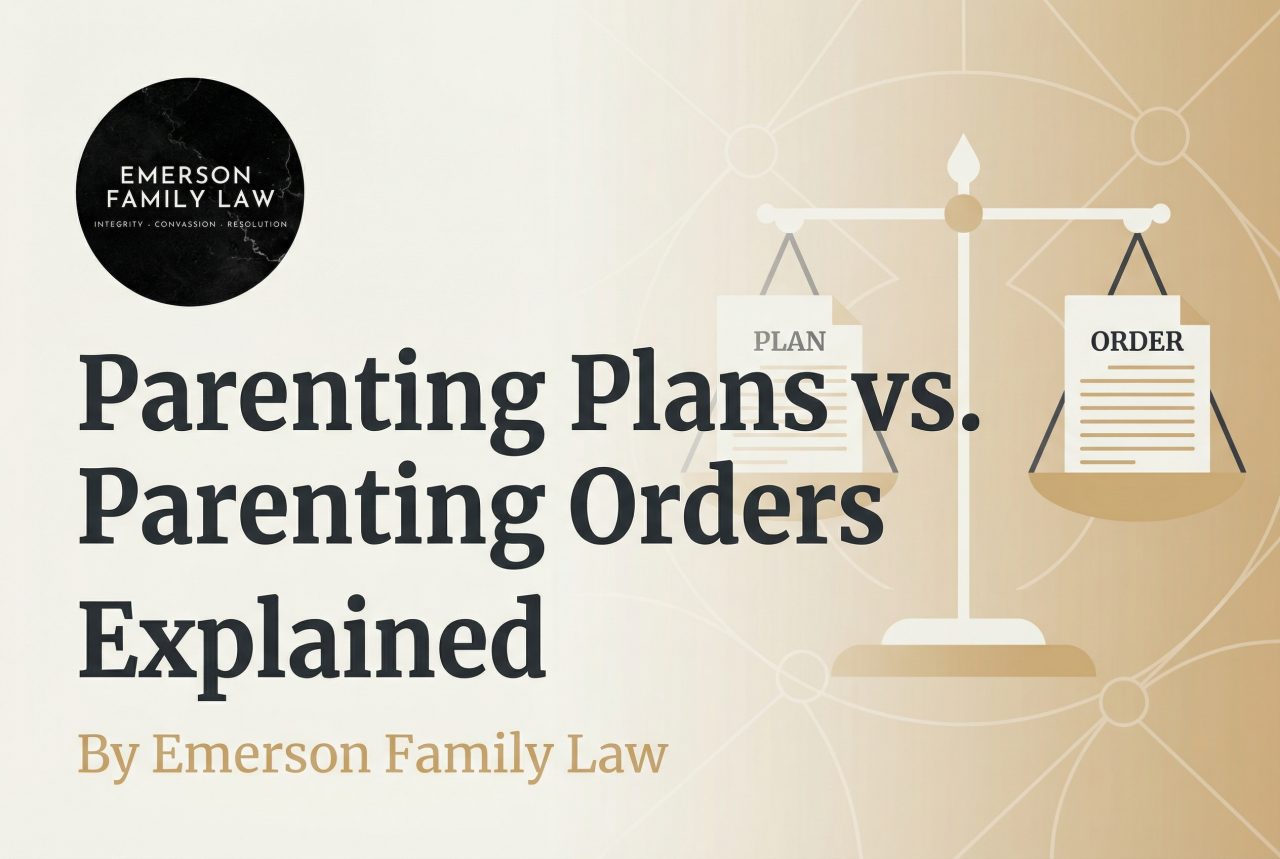
A parenting plan is flexible but not enforceable as a court order. A parenting order is enforceable but less flexible to change.
In practice, the right choice depends on your level of trust, the level of conflict, and whether you need the certainty of enforceability.
When a parenting plan is usually the right choice in Australia
A parenting plan in Australia often works best when parents are still able to negotiate in good faith.
This is common when separation is recent and parents are still working out what is realistic, particularly around rosters, childcare, and schooling. It can also suit families who want to keep arrangements child-centred without turning every change into a legal process.
Parenting plans can also be useful for families who decide they need parallel structures because co-parenting communication is not realistic. Emerson Family Law’s explanation of parallel parenting in What is Parallel Parenting and How Does it Differ to Co-Parenting? is helpful if you’re dealing with high conflict but still want stable arrangements for your children.
A parenting plan is often a sensible starting point if:
- there is no history of repeated broken agreements
- both parents can follow a routine without constant renegotiation
- neither parent needs legal protection to secure time or decision-making
When parenting orders are usually the better option
Parenting orders are usually the safer choice where certainty matters more than flexibility.
You should consider parenting orders if any of the following are present:
- repeated cancellations, late changeovers, or shifting arrangements
- ongoing conflict or control dynamics
- serious disagreement about schooling, medical decisions, or travel
- relocation risks
- the need for clear boundaries and enforceability
If you are already at the point where one parent is not following existing orders, Emerson Family Law’s guide What Are the Consequences If You Breach a Family Court Order? explains the enforcement pathway and why early advice matters.
For the Court’s step-by-step guidance on what to do when orders are breached, the Federal Circuit and Family Court explains options in its compliance with parenting orders fact sheet, and the filing process is outlined in the Court’s Application for Contravention form page.
The nuance many parents miss: parenting plans can affect existing parenting orders
This is where people can unintentionally create legal risk.
Even though a parenting plan is not enforceable like orders, a later parenting plan can sometimes affect how existing parenting orders are interpreted in practice, particularly if it shows the parents later agreed to a different arrangement.
This is why we usually recommend parents get legal advice before signing a parenting plan when they already have orders, especially where the change is substantial or there is a history of disputes.
If your goal is to change the existing order safely, the cleaner pathway is often to formalise the new agreement through consent orders using the Court’s consent orders process.
Up-to-date law: what changed from 6 May 2024 and why it matters here
Family law changed in a meaningful way in May 2024.
The Federal Circuit and Family Court’s official overview of the reforms is set out in Family law changes from 6 May 2024, including changes to:
- how the Court determines a child’s best interests
- how decision-making about major long-term issues is approached
- removal of the old presumption framework that many parents misunderstood
The key practical point for parents is this:
Courts now apply a simplified best interests framework with a strong focus on child safety and workable arrangements.
Even if you are agreeing privately, it is wise to structure parenting arrangements in a way that aligns with the current “best interests” approach. Emerson Family Law discusses best interests in What Does Best Interests of the Child Mean in Family Law?, which is a helpful internal reference point for how courts think about parenting outcomes.
Decision-making: parental responsibility vs time with children
A common point of confusion is mixing up “time” with “decision-making”.
One parent can spend significant time with the child while decision-making arrangements are structured differently. This is why it helps to understand parental responsibility concepts, particularly since the 2024 reforms reshaped how decision-making is approached.
If you are trying to understand what “sole parental responsibility” means, Emerson Family Law explains it clearly in What is Sole Parental Responsibility and How Can You Obtain It?.
If your question is more about what meaningful time looks like, Emerson Family Law addresses the concept in What Do We Mean by Substantial and Significant Time in Family Law?.
And if you are feeling anxious about whether you are “allowed” to seek time with your child after separation, Emerson Family Law’s overview What Are the Father’s Rights After Separation in Australia? is a useful myth-buster for many parents.
Practical considerations that make parenting documents work in real life
Most parenting arrangements do not fail because parents did not “care”.
They fail because the agreement was vague, unrealistic, or did not plan for predictable pressure points.
Whether you are doing a parenting plan or parenting orders, the best drafting focuses on clarity and conflict prevention.
1) Make the routine specific
Instead of “as agreed”, specify:
- exact days and times
- exact changeover location
- what happens if a child is sick
- how late is “late” before it becomes a missed changeover
Poor drafting is one of the drivers of enforcement disputes, which Emerson Family Law discusses from a practical standpoint in its publication Update on Shared Parenting.
2) Plan for school holidays and special days
School holidays are where disputes often escalate.
If you want a practical framework for holiday time, read how Emerson Family Law approaches this in Arrangements Over the School Holidays, then build a schedule that is predictable and fair.
3) Include a dispute pathway
Many families avoid repeated conflict by agreeing in advance how disputes will be handled:
- direct discussion first
- then mediation
- then lawyers if necessary
- court as a last resort
This is especially important in high-conflict dynamics. If you suspect co-parenting communication will never be healthy, Emerson Family Law’s explanation of parallel parenting in How Parallel Parenting Differs to Co-Parenting is often a more realistic model than forcing constant negotiation.
4) Watch out for relocation and “where the children live” disputes
Relocation questions can become urgent quickly.
If that is already on your horizon, Emerson Family Law’s publication on residence, separation and relocation is worth reading early because it highlights the factors that commonly drive disputes about where children live.
5) If you are dealing with alienation concerns, get advice early
Allegations of alienation are serious and complex, and they can change the trajectory of a parenting matter.
If this is a concern in your family, Emerson Family Law outlines what it means and how it is treated in What is Parental Alienation in Australian Family Law?.
Parenting plan vs parenting order: how to choose
If you want a calm way to decide, ask these questions:
Choose a parenting plan if:
- both parents are following agreements consistently
- flexibility is genuinely safe and workable
- you are still testing routines
- you want a low-conflict, non-court starting point
Choose parenting orders if:
- one parent is unreliable or repeatedly changes arrangements
- there is significant conflict or power imbalance
- you need enforceability to protect stability
- key issues like school, health, travel, or relocation are disputed
And if you already have orders but need change, Emerson Family Law explains the process and what courts require in Changing Parenting Orders in Qld: The Process, which is relevant to many Brisbane families but also reflects the broader approach to variation principles.
Frequently asked questions people search for
Are parenting plans legally binding in Australia?
A parenting plan is a written agreement, but it is not a court order. That means it does not operate like enforceable parenting orders. If you need enforceability, consider formalising an agreement through consent orders, which Emerson Family Law defines in The ABCs of Family Law, and the Court explains in its consent orders application guidance.
Can a parenting plan override parenting orders?
It is risky to assume it is “irrelevant”. A later parenting plan can sometimes complicate interpretation of existing arrangements. If you want to change orders properly, it is often safer to formalise the change through consent orders rather than relying on informal documents using the Court’s consent orders process.
What happens if someone breaches parenting orders?
If parenting orders are breached, the Court can deal with it through compliance and contravention processes. Emerson Family Law discusses consequences in What Are the Consequences If You Breach a Family Court Order?, and the Court sets out enforcement options in its compliance with parenting orders fact sheet.
Will the 2024 family law changes affect existing parenting orders?
Existing orders are not automatically rewritten, but the legal framework that applies to any new parenting proceedings changed from 6 May 2024. The Court explains the reforms in its overview of family law changes from 6 May 2024, and Legal Aid Victoria summarises what the changes mean in its reforms explainer.
A note on tone, safety, and your child
If you are in a situation where trust is low, conflict is high, or reliability has been an ongoing problem, formalising arrangements can be a stabilising step for everyone involved.
If you want to explore your options in a way that is practical and child-centred, tell us more about your situation through the form below.



Gavin Lai
LLB. (UQ) GradDipLP
Gavin Lai is a seasoned Family Law Solicitor with over 20 years of experience in top firms in Brisbane. He specialises in complex parenting and financial cases, international family law (including Hague Convention matters), and creating financial agreements for couples. Gavin is adept at managing high-stakes cases involving business and trust restructuring. As a staunch advocate for alternative dispute resolution, he seeks to resolve matters amicably, resorting to court only when necessary.
